Mildred Khavwani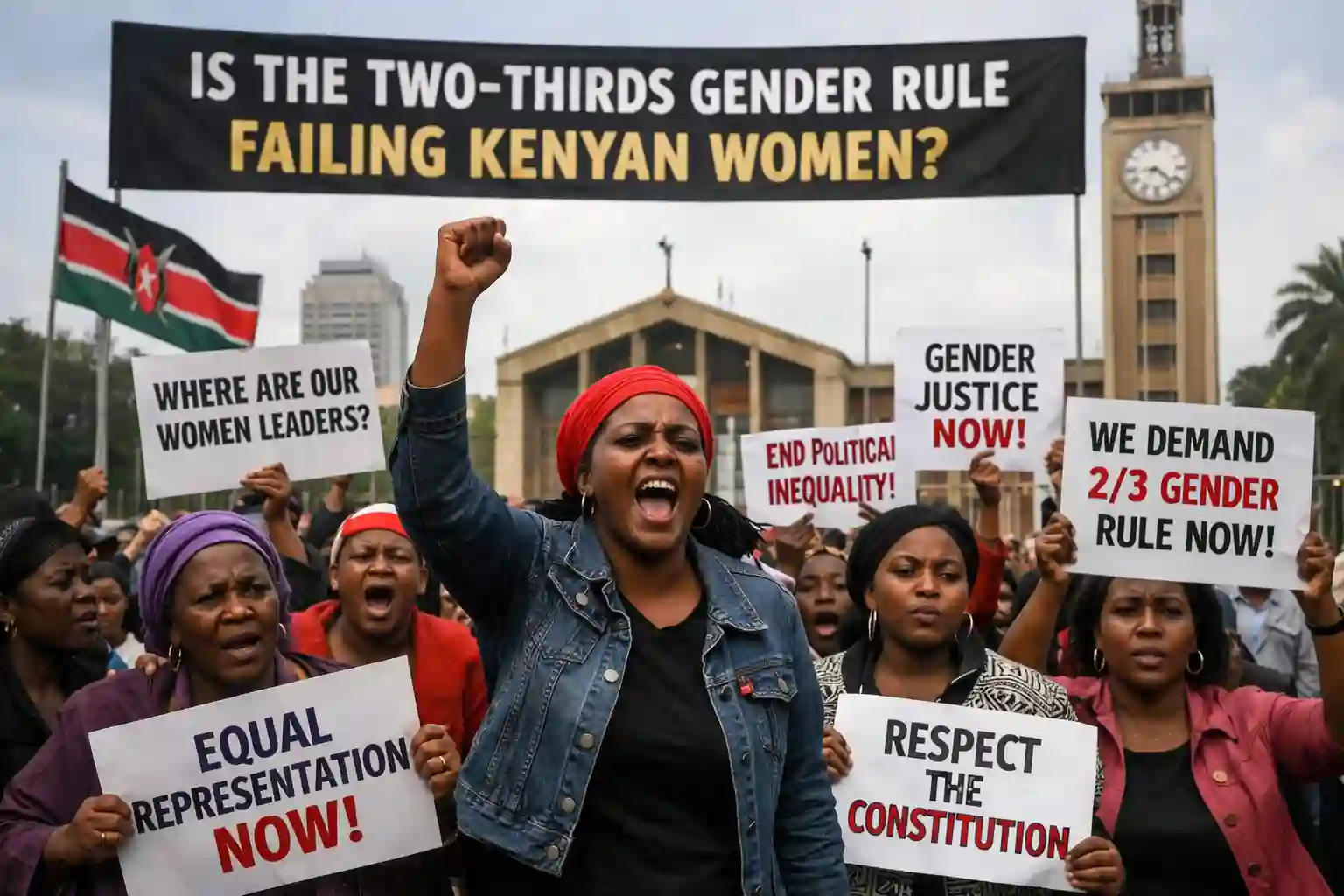
Two-Thirds Gender Rule: Fifteen years have passed since Kenya’s 2010 Constitution promised women a seat at the table. The two-thirds gender rule seemed like a victory. Today, that promise lies broken. Kenyan women remain locked out of power. Parliament refuses to act. Even the courts document this failure in case after case.
Parliament Ignores the Constitution
Look at the court record. In July 2025, Justice Lawrence Mugambi handled yet another gender rule petition. Three women—Margaret Toili, Eddah Marete, and Agnes Ndonji—asked the High Court to dissolve Parliament. Their reason? The 13th Parliament broke the Constitution just like every Parliament before it.
Justice Mugambi did not dismiss them. Instead, he sent their case to Chief Justice Martha Koome. He warned that “this question, unless resolved, will keep on recurring with every Parliament that comes up after every general election.”
Think about that. A senior judge admits the same failure happens again and again. Each new Parliament arrives, promises change and delivers nothing. The women who brought this case know the pattern. That is why they want Parliament dissolved entirely.
The President Breaks Gender Rules Too
Parliament is not alone. The Executive branch shows equal contempt for women. In August 2025, Katiba Institute and the Kenya Human Rights Commission (KHRC) sued President William Ruto. The case? His nomination for Chairperson of the Kenya National Commission on Human Rights.
Here is the violation. clearly: “The chairperson and vice-chairperson of a commission shall not be of the same gender.” The current Vice-Chairperson, Dr. Raymond Nyeris, is male. Yet the President nominated another male for Chair. That gives the commission two male leaders. Zero women.
https://new.kenyalaw.org/akn/ke/act/2010/constitution/eng@2010-09-03
The petitioners did not hold back. They accused the President of violating “the right of women to equal treatment, including the right to equal opportunities in political spheres.” They said the selection panel “could only have been filled by women candidates” for that position. Yet the system chose a man.
This is not confusion about the law. This is deliberate choice. The President saw the constitutional ban on same-gender leadership. He ignored it. And this happened at the human rights commission of all places.
The State Punishes FGM Survivors
The failure goes beyond political seats. In June 2025, a new petition hit the High Court at Narok. The allegation shocked many. Kenya remains “the only country in the world that applies its anti-FGM laws in a manner that punishes victims rather than protecting them.”
Read that again. Police arrest women and girls who survived female genital mutilation. The state prosecutes them. Courts convict them. For being victims. Officers also force survivors to undergo genital examinations. The court recognized this as a violation of “dignity, privacy, and bodily integrity.”
The High Court issued orders to stop forced examinations. But why did this practice continue for years? The 2016 case of KL v Republic already declared relevant laws vague. Yet nothing changed. The state kept hurting the very women it should protect.
Courts Block Reproductive Rights
Women face barriers even when they seek healthcare. In October 2025, the High Court struck down part of the National Reproductive Health Policy. The problem clause required doctors to consider “the highest attainable standard of health of the unborn child” when women sought legal termination.
The court found this clause violated Article 26(4) of the Constitution which states ”(4) Abortion is not permitted unless, in the opinion of a trained health professional, there is need for emergency treatment, or the life or health of the mother is in danger, or if permitted by any other written law”. But petitioner Rachael Mwikali pointed to a deeper failure. “The process excluded and marginalized key groups most affected,” she said. “Myself included.”
Women won that case. Yet they lost the chance to shape the policy in the first place. That pattern repeats everywhere. Men make the rules. Women fight in court to undo the damage. Then the cycle starts again.
What the Numbers Show
The statistics confirm what the cases reveal. Women hold less than 24 percent of parliamentary seats. The Constitution demands at least 33 percent. Five different bills to enforce the gender rule have collapsed in Parliament. Each time, male lawmakers simply stay away or deny quorum.
The women’s representative positions created in 2010 were meant as a temporary fix. Fifteen years later, they remain the main path for women into politics. Few counties have ever elected a woman as governor or senator. Voters who are women often refuse to vote for women. Internalized patriarchy hurts everyone.
The two-thirds gender rule fails at the county level too. Take the Makueni County case from August 2025. Petitioners Justus Mutunga Mutuku and Joseph Kioko Mutisya challenged the Wote Municipality Board’s appointments. Why? The county government ignored gender parity entirely. Shockingly, Makueni defended itself by saying 5 men and 4 women had “surpassed the one-third rule.” But the Constitution demands full compliance, not bare minimums. Moreover, the recruitment process was opaque—no public ads, no competitive applications, just backroom deals. The County Assembly? It “remained mum” instead of vetting. This quiet failure repeats across Kenya. From Nairobi to Makueni, women lose seats through silent neglect, not dramatic battles.
The Verdict
The two-thirds gender rule is failing Kenyan women. Not by accident. By design. Parliament refuses to pass enabling laws. The President ignores clear constitutional bans. Police arrest FGM survivors. Courts stay busy cleaning up everyone else’s mess.
Justice Mugambi said the gender question will “recur with every Parliament” until someone imposes consequences. He is right. The Constitution is clear. The will to follow it does not exist.
Kenyan women have waited fifteen years. The time for patience ended long ago. Either the courts dissolve Parliament, or the people demand new leaders. But waiting for men to share power voluntarily? That strategy has failed completely.
Read more news: https://www.kenyanewsupdates.co.ke/2026/04/05/cameroon-vice-president-role-restored-after-parliament-approval/
Discover more from Kenya News Updates
Subscribe to get the latest posts sent to your email.


 Maxwell Aliang'ana